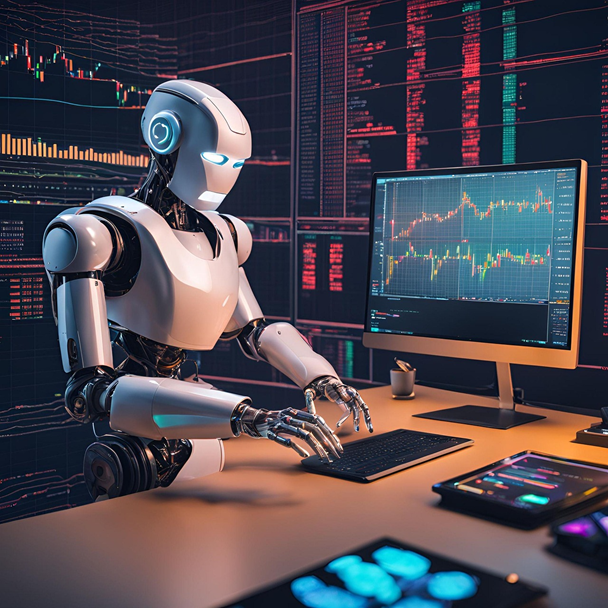
Something changed on trading desks a few years back, and it happened quietly. The printed economic calendars disappeared. So did the hand-drawn trend lines on laminated charts. Nobody announced it. The tools just got better, and people started using them. Now those same desks run sentiment models, live news feeds parsed by language algorithms, and pattern engines crunching data that no human analyst could get through in a week.
For Indian traders, the timing of all this is interesting. Retail participation in currency markets has grown steadily, and forex trading is genuinely more accessible than it was a decade ago — not just for institutions hedging export exposure, but for individual traders sitting in Pune or Hyderabad with a laptop and a brokerage account. The question now is whether those traders are using the tools available to them, because the ones who are not may find themselves at a growing disadvantage.
Reading Sentiment Before the Price Moves
Central bank language is carefully chosen. Every word in an RBI or Federal Reserve statement is deliberate, and experienced traders have always tried to read between the lines. The problem is time. By the time a human analyst has worked through the nuances of a policy document, the market has usually already moved.
Natural language processing models do this faster. They scan statements, compare phrasing to previous communications, detect subtle shifts in tone, and generate a signal. Not perfectly — nothing in trading works perfectly — but quickly enough to matter. For rupee traders watching USD/INR tick around a Fed decision, that speed has real value.
Patterns Humans Would Never Catch
Price data leaves traces. Certain setups recur across currency pairs, certain volume behaviours precede directional moves, certain correlations between assets hold until they suddenly do not. Traders have known this for years. The difficulty has always been scale — there is simply too much data for manual analysis to cover properly.
This is where machine learning earns its place. Models trained on years of historical tick data can surface patterns across dozens of pairs simultaneously, flagging setups that would never make it onto a human analyst’s radar. For anyone trading USD/INR, EUR/INR, or the major pairs through an international broker, this kind of edge was practically inaccessible not long ago. That has changed.
Risk Management That Actually Adapts
Position sizing, drawdown limits, volatility adjustments — most traders know these matter. Fewer manage them dynamically. Static risk rules set on a calm Monday have a habit of being completely wrong by Thursday when conditions have shifted.
AI-driven risk tools update in real time. They adjust to what the market is actually doing rather than what it was doing when the parameters were last set. For retail traders especially, this kind of adaptive discipline can be the difference between a bad week and a blown account.
The Part AI Still Cannot Do
A genuinely unprecedented event — a surprise policy reversal, a sudden geopolitical rupture, a liquidity shock with no historical parallel — will confuse any model trained on what has happened before. History rhymes but it does not always repeat, and the moments when it stops rhyming are exactly when over-reliance on any system becomes dangerous.
The traders getting the most out of AI analytics tend to treat it as a sharper set of instruments, not a replacement for thinking. The data has improved enormously. The judgement still has to come from somewhere else.
Leave a Reply