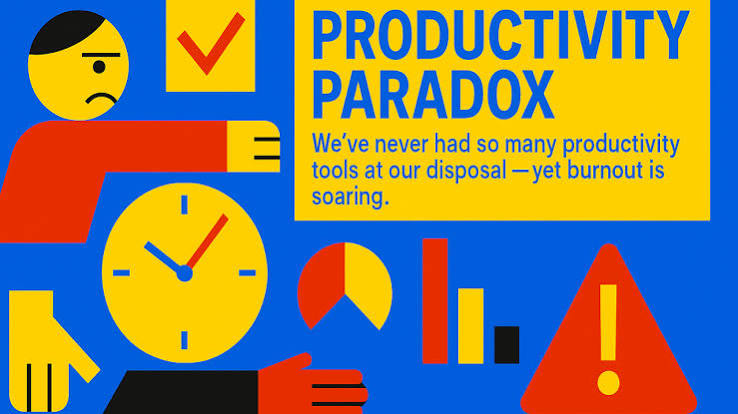
Productivity is the subject of my research. There is one thing about which I am constantly discovering some interesting information. The idea of the tool paradox fascinates me because we think that having more and more tools makes us better equipped and thus makes us more productive, whereas, in fact, it is the other way around. After a certain amount of tools comes into play, we begin to suffer from decisions, fragmentation, and overhead costs that hinder our productivity.
More options, more friction
Each new tool comes with a decision. Which? When? How? With just a couple of tools, this is negligible. With lots of tools, deciding what to use, when to use it, and how to use it takes up actual effort on your part. But each individual decision doesn’t feel important enough, so you don’t see the cumulative cost. Your ability to use all those tools ends up going right out the window in that inefficiency.
This has been tested by me in knowledge workers, and I found that the same holds true for them as well. In other words, the people who use the most tools are generally not the most productive; rather, they are the most fragmented and spend their time using different applications, setting up their computers, and fiddling around with their machines, thereby using less time on their actual task.
Depth beats breadth
The benefit of having a limited set of tools is that it enables one to master them. If one uses few tools on a regular basis, then one will master those tools, and mastery leads to being skilled. If one tries to cover too many tools, one remains a beginner forever in all of them because none of them become a mastered skill. Depth with a few tools is better than breadth with many.
The sensible action is to pick some trustworthy tools that can take care of most of what you need without constantly trying to get more. I keep my own stack deliberately small, using a handful of online AI tools for the recurring work rather than chasing every new option that appears, and the focus pays off.
The novelty trap
Tool acquisition is motivated by novelty. The idea that the new tool represents something better, some sort of upgrade, which makes us feel like we’re making investments in productivity. Our minds are programmed in such a way as to think that there’s always going to be a tool in the future that will unlock our potential. But acknowledging that this is nothing more than an emotional trigger will allow us to break free from it.
In this approach, the introduction of a tool is treated as an expense rather than something that comes for free. Every introduced tool has to justify itself in light of the added complexity, and most won’t be able to do so. By setting your standards for the addition of a tool, you will always keep your stack lean, fluent, and productive. Your existing tools will be enough in most cases.
Auditing your stack
One way to do this is to take an honest inventory of the tools you have. Write down everything you own, and then ask yourself if the tool actually earns its spot or if you simply hang onto it because you are used to having it or because you have hope for it. Get rid of the tools that do not earn their spot. You’ll be surprised at how much better this will make you feel.
Less, but better
If despite all your available resources, you find yourself unable to focus, then the problem could actually lie in the resources themselves. Take the minimalistic approach and watch your productivity soar. Building on a small set of dependable options like a this free AI tool approach keeps the focus on the work instead of the system.
The paradox of tools is indeed real and experienced by many. The more there are available, the greater the possibilities and even the potential for conflict. The best productive individuals are never those with the best tools; rather, they are those who are the most concentrated with only a minimal number of tools at their disposal. For maximum productivity, then, it would mean having fewer rather than more tools.
The quiet cost of switching
Among the expenses associated with an expansive suite of tools that few recognize is that of context-switching. Whenever you switch from one tool to another, your attention has to recalibrate, and that recalibration does not come without cost; it fractures your attention and saps you of the sustained focus necessary for effective work. A worker who toggles through a dozen programs in a given day will find that a surprisingly large portion of his or her day is spent moving from one program to another without ever getting into the zone where great things happen.
This is because a minimal toolset allows one to focus much more easily because there is simply less to juggle. If one can find a handful of well-understood tools that address most of their needs, then they will be able to concentrate on what really matters for far longer periods, resulting in better output than ever before. This is the subtle benefit of simplicity that is always overlooked by the novelty-loving brain; it is not about keeping a certain set of tools, but rather avoiding having to switch between them.
Leave a Reply